

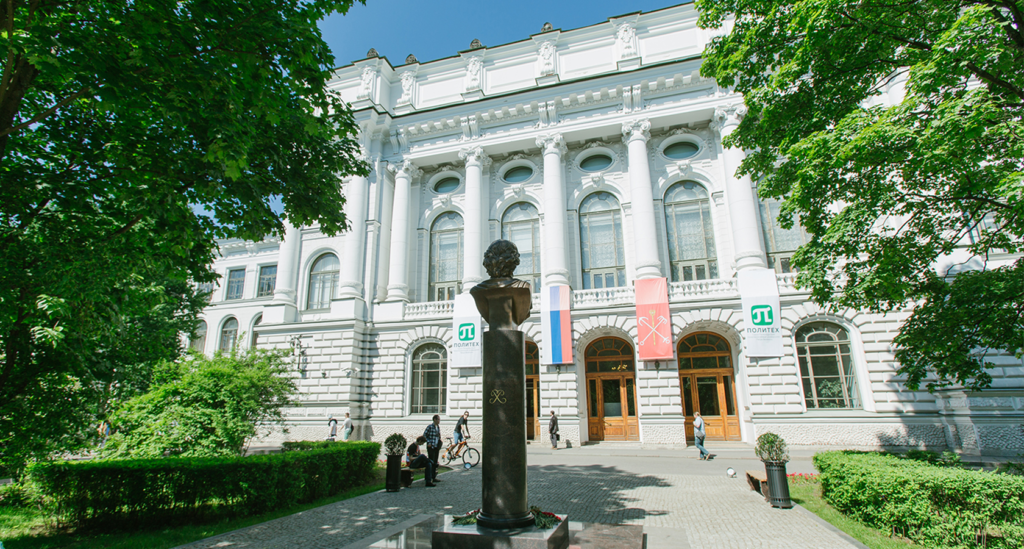
Peter the Great St. Petersburg Polytechnic University (SPbSTU)
On February 19, 1899, Emperor Nickolay II signed the Decree on founding Polytechnic Institute in St. Petersburg.
In the establishment of the Institute, its founders followed the principles of Peter the Great and sent specialists to Europe to explore operation of European universities. In the result of these efforts, the idea of a Polytechnic Institute complex emerged and the institute was designed following the model of university cities of Oxford and Cambridge.
In the 120 years of its existence, Polytechnic Institute has several times changed its names and structure, but it remained the Polytechnic and now is called Polytechnic University. Since the very first years of its existence, the university had been training highly qualified specialists for the industry, and this remains the essential feature of training bachelor’s, specialists’, master’s degree holders and postgraduate students at Peter the Great St. Petersburg Polytechnic University.
Contacts
- Address
- Russia, 195251, St.Petersburg, Polytechnicheskaya, 29
- Phone
- +7 (812) 297-16-16
- intadm@spbstu.ru
- Internet
- https://spbstu.ru
- Social networks
Laboratories \ equipment supporting education
Detailed information is available here https://english.spbstu.ru/science/structure/research-centers/
Academic and research staff
Teaching staff - 1987 pers.
International teaching staff - 209 pers.
Other staff - 3508 pers.
Totall Teaching staff - 1987 pers.
- Intrenational teaching staff - 209 pers.
- DSc, full professors - 19.3%
- PhD, associate professors - 54,3%
- Assistants professors, teachers, instructors - 14.3%
Staff professional development and training in nuclear area
SPbPU Center of continuous education:
SPbPU employees have the opportunity to improve their skills in the following forms:
- training under the programs of additional professional education at the Institute of Additional Education of SPbPU (at the expense of the federal budget);
- training under additional professional education programs in third-party educational and scientific organizations that have the appropriate license.
https://ido.spbstu.ru/obuchenie_sotrudnikov/
SPbPU filial in Sosnovy Bor: https://sbor.spbstu.ru/institute/
The Institute of Nuclear Energy was established in 1996 on the initiative of the St. Petersburg State Polytechnic University and the Leningrad Nuclear Power Plant, with the support of the Mayor of the city of Sosnovy Bor, the Governor of the Leningrad Region, nuclear industry enterprises and the Ministry of Atomic Energy of Russia. The purpose of establishing the institute is to train highly qualified specialists who have a deep understanding of the physical processes occurring in nuclear power plants by bringing the preparation closer to the main production.
Institute provide retraining programmes: https://sbor.spbstu.ru/povyshenie_kvalifikacii/
Available academic programs
Information for Students is available here https://english.spbstu.ru/education/admissions/
Network Academic Programs with international partner universities
For “Power Plant Engineering” program
- MSc in Power Plant Engineering awarded by SPbPU, Russia
- Diploma is awarded by SPbPU, Russia, and certificate from a partner university about mobility semester (foreign university)
- Double Degree option (temporary stoped): awarded by Lappeenranta University of Technology, Finland and SPbPU, Russia
For “Electrical Engineering” program:
- MSc in Electrical Engineering; awarded by SPbPU, Russia
- Diploma is awarded by SPbPU, Russia, and certificate from a partner university about mobility semester (foreign university)
- Double Degree option (temporary stoped): Brandenburg University of Technology Cottbus-Senftenberg, Germany — MSc in Electrical Power Engineering
- Double Degree option (temporary stoped): Lappeenranta University of Technology, Finland — MSc in Electrical Engineering
For “Nuclear Power Engineering” program:
- Diploma: awarded by SPbPU, Russia
- Diploma is awarded by SPbPU, Russia, and certificate from a partner university about mobility semester (foreign university)
Unique Triple Master Degree “Energy Technolody” (temporary stoped) designed in cooperation with Lappeenranta University of Technology (Finland) and Leibniz University of Hannover (Germany).
International projects in nuclear area
Master Degree program «Emergency preparedness and response» is based on a curriculum developed by the IAEA in collaboration with international experts and scientists. It complies with IAEA safety standards, which include specific information on how to ensure an appropriate level of preparedness and response to a nuclear or radiological emergency. The curriculum offers a set of core and elective courses to build comprehensive knowledge in this area. The core modules provide information on general, functional and infrastructural arrangements relevant for emergency preparedness and response in line with the IAEA’s safety standards, while suggested electives provide more detail on topics such as assessment and prognosis, medical radiation emergency management, development or emergency plans, communication and advanced EPR technologies.
Controlled thermonuclear fusion – to recreate the Sun’s energy on Earth. ITER – the world's largest tokamak, a magnetic fusion device that has been designed to prove the feasibility of fusion as a large-scale and carbon-free source of energy. Scientists of Polytech perform the plasma simulation; they developed the official simulation code SOLPS-ITER.
Outstanding Alumni
The first graduation of students of international programs took place in 2017. Graduates work in various nuclear power plant in their countries, in energy companies, pass on the knowledge gained at SPbPU to university students in their countries. Some graduates decided to continue their postgraduate studies at SPbPU, at the universities of Canada, Finland, Germany and others.
For example, a graduate of the master's program Hashim Al Zuwaini completed postgraduate studies at SPbPU, defended his Ph.D. thesis, and now works at one of the Iraqi universities.
If we talk about graduates of Russian-language programs, then the most outstanding graduates are:
1. Mikhail Oseevsky - President of PJSC Rosseti
2. Vadim Vederchik – Managing Director of TGC-1 PJSC
3. Eduard Lissitzky - Deputy Managing Director for Development and Property Management
4. Yuri Skok - Deputy. Director of Leningrad NPP
5. Ivan Babich - Head of the Technological Control Service of the First Stage of Leningrad NPP